Using what's already there, working even in dry conditions.
Maintaining field and gravel tracks has to be simple, fast and affordable. That's exactly what our VGrader, the V12 ripper and the Bankettschild 2.0 stand for. They enable resource-efficient track maintenance with little manpower, low power requirements and as little new material as possible. Our core idea: process and recover the material that's already on the track, and put it back to use as well as possible.
Our equipment is designed so that municipal yard staff can work well with it after a clear briefing. No special experience in arable farming or a team of track-building specialists is required. One person familiar with the towing vehicle can take on track maintenance — straightforward and easy to fit into everyday yard work.
The particular advantage: the V12 can also work dry, hard track surfaces. That opens up extra opportunities for local authorities and makes track maintenance easier to plan.
Moisture plays a decisive role in track maintenance. If a track is too dry, the hard surface is often difficult to work. If it's too wet, the material can clump and spread poorly. The right window of time is therefore often limited.
This is exactly where our V12 comes in. Its spring-mounted tines work the upper, hardened layer in a targeted way. They scratch open the surface and loosen the material without, when set correctly, digging deep into the load-bearing base.
The V12 was developed for the fast working style of our VGrader. It makes the near-surface material usable again for the maintenance pass that follows. That means the combination can be used effectively even in dry conditions.
On many field tracks, a grown-over ridge forms between the wheel tracks. It often contains valuable track material. Our approach: recover this material as fully as possible and put it back to use.
At the front, the V12 loosens the hardened surface and breaks up the grown-over ridge. At the rear, the VGrader picks up the loosened material, mixes it and spreads it back over the track. Especially in dry conditions, the loosened material can be processed well.
What matters here is the right material mix: a stable gravel track needs suitable fine particles alongside the coarser grains. Loosening the ground makes existing fine particles usable in the mix again. How much material can be recovered depends on its composition and how overgrown it is.
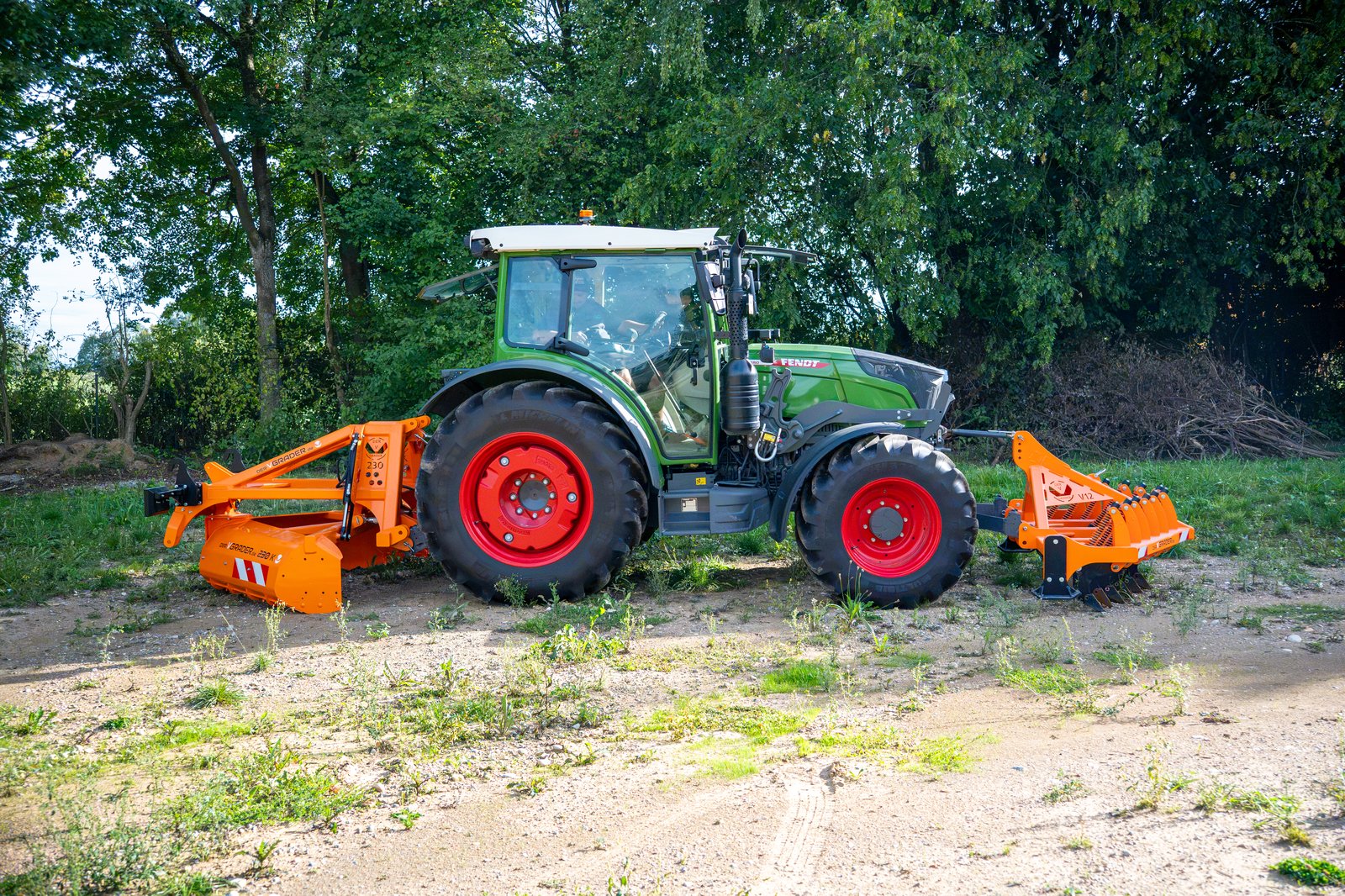
Valuable material is also left lying at the edge of the track — material that's missing from the driving surface. With our Bankettschild 2.0, we can work the verge in both directions: material can be cleared outward, or brought back from the edge onto the track in a targeted way.
That way, suitable track material that has built up at the side is brought back to where it's needed. It can then be spread with the VGrader and worked into the existing track surface.
That's recycling right on the spot: recovering existing material, reusing it, and reducing the need for new gravel and stone.
For us, conserving resources starts right there on the track. Whether from the hardened surface, the centre ridge or the verge: whatever is there and suitable should be reused as well as possible. That saves material, transport and costs.
The V12 ripper, Bankettschild 2.0 and VGrader complement each other here: loosening, recovering, processing and spreading. Each of these tasks can be done by one person with the right towing vehicle.
With a working speed of 15–20 km/h, the VGrader enables fast, economical track maintenance. The V12 is also designed for high working speeds; the right speed depends on the track, the equipment in use and the working conditions.
One example: for a municipal field-track network of around 40 kilometres, a maintenance pass with the VGrader over the entire network can, under suitable conditions, be completed in around half a day.
That describes a single maintenance pass. Using the ripper or the Bankettschild may require extra working time depending on the condition of the track. Depending on condition and base material, several passes per job may also be needed. Recurring maintenance runs are also required over the course of a year — how often depends on the track, how much it's used, and the weather.
That's exactly why the fast, simple way of working is so valuable: regular maintenance can be planned into everyday yard work with a manageable amount of time and cost.
By maintaining the tracks within their remit, local authorities make an important contribution to road safety. The legal framework is set, among other things, by the duty to maintain roads — in Bavaria governed by Article 9 of the Bavarian Roads and Tracks Act — and by the duty of traffic safety.
For municipal yards, that's a demanding task: staff, time and budgets are limited. If elaborate measures cover only two or three kilometres a year, for example, there's often little room left for maintaining the rest of the network — even though the whole network needs attention.
Our equipment system makes regular maintenance across the whole network easier to achieve. The fast way of working, the low staffing requirement and the reuse of existing material make economical maintenance possible. That lets local authorities cover more track length in their ongoing upkeep and respond to emerging damage at an early stage.
The goal is to reduce potholes, ruts and unevenness through suitable maintenance and to keep tracks usable in the long term. Recurring maintenance rounds support safe use and help avoid larger damage and costly repairs. Regular inspections and specifically securing particular hazard spots round out this maintenance.
Few horsepower. One person. Well-kept tracks.
Simple controls, low pulling-power requirements and short operating times help save diesel, staff time and running costs. Compared with large graders, the VGrader offers an affordable solution for the ongoing maintenance of municipal field and gravel tracks.
Everyone benefits: the yard through predictable work, the municipality through economical use of funds, and residents through better-kept tracks — whether cycling, walking, out with the dog, or working the land.
Our philosophy: use the material that's already there. Recover it instead of losing it. Keep the entire track network in good shape, sustainably and economically.
Get free, no-obligation advice — we'll show you which solution fits your tracks.
Get in touch